
Learning how to self publish a book in UK is easier than ever before. The new online book publishing platforms give the author greater control of the entire process, from editing to pricing, distribution to marketing, and allow him to keep more of the profits. You don’t have to wait months or years for your manuscript to get to the publisher; you can do it on your own schedule.
However, it’s not just about uploading a document to Amazon to publish a professional book. You’ll need to revise your manuscript, format it properly, register an ISBN, and familiarize yourself with your legal responsibilities and choose your distribution channels. Each one contributes to the creation of a book which will be read and welcomed by readers and sellers.
This is a self publishing UK guide that guides you through in simple English. You’ll find out how to do this when you prepare your manuscript, how to register an ISBN through Nielsen, what British Library Legal Deposit is and how it works, how to calculate Amazon KDP UK royalties, and whether it’s the right route for you to take when it comes to self-publishing in the UK.
Quick Answer: How to Self-Publish a Book in UK?
First of all, you’ll need to complete your manuscript, edit and format it professionally, create a high-quality cover, obtain an ISBN through Nielsen, and upload your files to a publishing platform such as Kindle Direct Publishing (KDP). Most UK authors can publish within a few days while retaining up to 70% royalties on eligible ebooks, although British Library Legal Deposit and UK tax requirements must also be completed.
Why More UK Authors Are Choosing Self-Publishing
Ten years ago, the publishing of a book was essentially a gamble on the book by the publisher. Today, the process is much more different.
For writers wanting greater control over their work, self-publishing in the UK has gained respect and greater popularity. New technology with print-on-demand and online publishing has enabled the publication of professional books without thousands of copies printed or a traditional publishing contract.
The figures illustrate this change. It is estimated by Bowker ISBN that over 2.6 million ISBN-registered titles were published in 2023, with the independent publishing taking another step forward toward growth. That steady rise indicates that more writers are opting out of the traditional publishing house model and publishing themselves.
One of the greatest pros for many writers is speed.
Typically, a book takes 12 to 24 months from the moment it is published to the time it hits readers. Finding a literary agent, submitting your manuscript, and waiting through multiple rounds of review can significantly extend that timeline.
Many of those delays are eliminated with independent publishing. After the files are completed, you can have your book available for sale in a few days.
Another great advantage is creative control..
Instead of handing key decisions to a publisher, UK self-published authors decide everything themselves; from the title and book cover design to pricing, publication dates and future revisions.
The financial gap is also significant.
Typical publishing deals are made at between 5% and 15% in royalties. In contrast, Kindle Direct Publishing (KDP) ebooks can make up to 70% of the royalties. The downside to independent publishing is that the writer must invest in editing and design, but they typically retain a higher percentage of each sale.
Self-Publishing vs Traditional Publishing in the UK
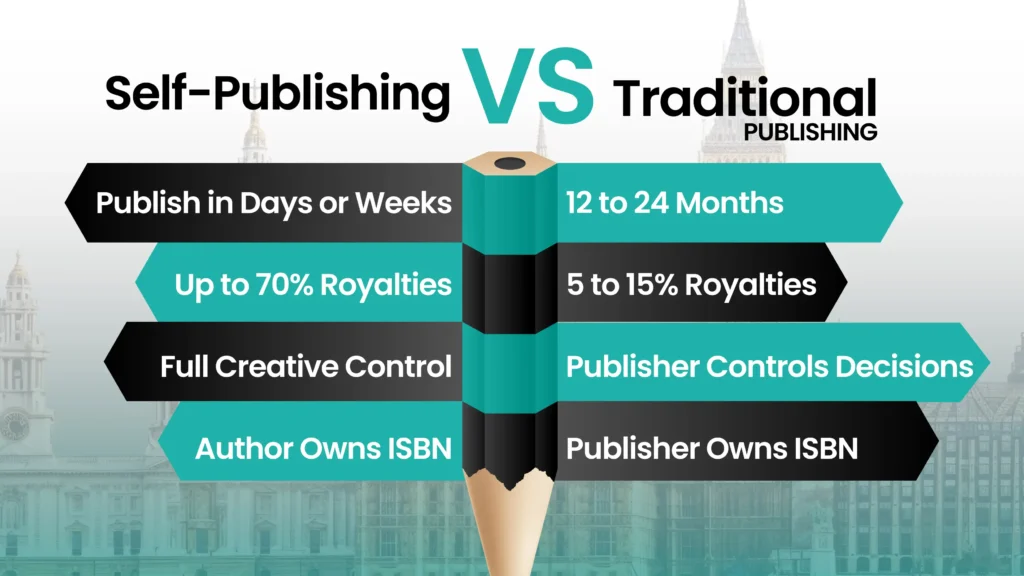
Whether you’re self-publishing a book or pursuing a traditional publishing deal, both routes can lead to a successful book, but they offer very different experiences.
For writers on the side of a traditional publishing house, the choice of traditional publishing may be the better one. But it does not always come easy.
There is normally a first hurdle: most UK publishers do not accept unsolicited manuscripts, which is why a literary agent is important. Once you have signed up with an agent it doesn’t mean that a publisher is going to pick up your manuscript.
With independent publishing, you’re in control instead.
You decide when to publish your book, what its price is going to be, where you are going to sell it and how you are going to market it. This is the degree of control that many writers might desire when they want to create a long-term publishing plan without having to wait for another person.
There’s one thing to keep in mind.
Respectable old-fashioned publishers will not request payment from writers for publication. If a company uses the term “traditional publisher” but still charges high publishing fees, it is a good idea to do thorough research on their publishing model before signing an agreement.
When you’re comparing publishing companies, read our guide to avoiding publishing scams to help you know what to look out for before you decide.
Here are the main differences of self publishing vs traditional publishing UK:
| Feature | Self-Publishing | Traditional Publishing |
| Publishing timeline | Days or weeks | 12–24 months or longer |
| Creative control | Complete | Shared with publisher |
| Royalties | Up to 70% for eligible ebooks | Usually 5–15% |
| Upfront investment | Author-funded | Publisher-funded |
| ISBN ownership | Optional | Publisher-owned |
| Marketing | Mainly author-led | Shared responsibility |
For writers who value flexibility, faster publication and higher earning potential, self-publishing in the UK has become an increasingly attractive option.
How to Self-publish a Book in the UK in 9 Steps
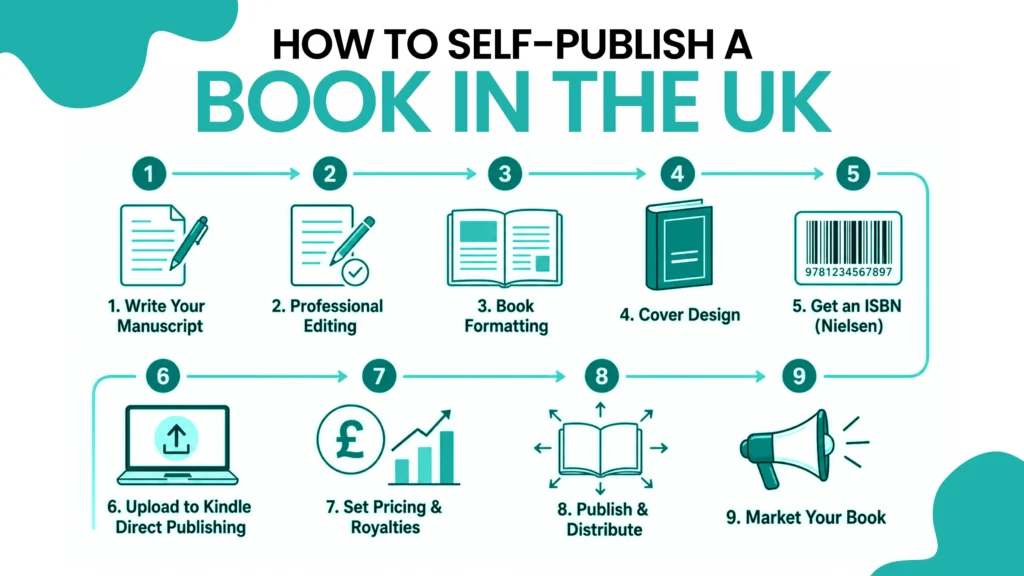
Step 1: Edit and Prepare Your Manuscript
All successful books start with a prepared manuscript.
The reader will excuse occasional errors, but a series of grammatical slips, confusing structure or inconsistencies in writing lose respect. A professional editor will help your book look polished and polished, and that will increase the likelihood of positive reviews.
If you’re learning how to self publish a book in UK, professional editing is one of the most important investments you can make before publishing
Typically, editing occurs in three steps.
Developmental Editing
Developmental Editing is more concerned with the quality of your content when self publishing a book UK.
An editor evaluates character development, dialogue, plot and pacing for fiction. In non-fiction, focus is now on organisation, clarity, logic and flow of ideas.
It’s not a voice change that’s your goal. To make your writing more convincing and to keep readers engaged in your content.
Copyediting
Copyediting is the process that further perfects the language once the structure is complete.
Grammar, spelling, punctuation, consistency, repetition and sentence flow are all checked and a cleaner more professional manuscript is created.
This stage also ensures consistency of names, dates, terminology and formatting throughout the book.
Proofreading
Proofreading is the final check before self publishing a book. It is meant to pick up the little typing mistakes that may go astray for the previous editing phases such as misspelled words, punctuation errors, inconsistencies in spacing and formatting errors that may be the result of the typesetting process.
Skipping this final check can leave an otherwise excellent book looking unfinished.
A polished manuscript gives your book the best possible start. If you’d like another pair of expert eyes before publishing, our professional manuscript editing service can help refine your work while preserving your unique voice.
Step 2: Format Your Manuscript for Print and Ebook
Formatting is an essential step in self-publishing a book, turning a Word document into a publication-ready manuscript.
Technical standards are different for print books and digital books, and the books are typically available in two different formats.
Well formatted books are easier to read, look professional and will lessen the possibility of publication errors after release.
Ebook Formatting
EPUB files are accepted by most publishing platforms, and Kindle Direct Publishing (KDP) accepts a number of file types, which it will convert to EPUB for Kindle devices.
A professionally formatted ebook will have:
- Clickable table of contents
- Consistent heading styles
- Clean paragraph spacing
- Responsive images
- Working hyperlinks where required
Formatting mistakes often lead to missing chapter breaks, inconsistent spacing and display problems across different devices.
Readers notice these issues quickly when self publishing a book.
A polished layout creates a far better reading experience.
Print Formatting
Print editions require a press-ready PDF prepared to the printer’s specifications.
Important elements include:
- Trim size
- Margins
- Bleed
- Gutter spacing
- Page numbering
- Font embedding
- Image resolution
Although these details seem technical, they have a direct impact on the finished book.
Professional formatting ensures your paperback looks just as polished as titles produced by established publishers.
Our book formatting service prepares publication-ready files for both print and digital distribution, helping you avoid costly production mistakes.
Creating files that meet publishing standards can be challenging, especially for first-time authors. Our interior layout and formatting service prepares your book for both print and digital publication.
Step 3: Design a Professional Book Cover
A book cover is often the first impression readers have when self publishing a book UK audiences will notice on online bookstores. Amazon shoppers or bookshop readers will appreciate a professional cover and will be more likely to click or pick up your book.
When it comes to book cover design, it’s particularly crucial for UK self-published authors. If there isn’t a publisher name on the book cover, you need to make a strong impression, as well as showing your work is of quality.
A good cover should:
A successful cover should:
- Match your genre
- Feature clear, readable typography
- Look professional as a thumbnail
- Appeal to your target audience
Keep in mind that print and digital will have different cover files. An ebook only requires a front cover, a paperback requires a full wraparound design, front cover, spine and back cover. The width of the spine will vary according to the number of pages and type of paper, so determine these factors before printing.
While you can produce a cover yourself using online design tools, a well-designed cover can give your book a better chance of being noticed by readers, and of standing out amongst the many books published in bookstores.
Having a professionally designed cover will make your book stand out from those that are traditionally published, and it will also help to gain the trust of readers.
Step 4: Get Your ISBN – Why Nielsen and Book Data Services (BDS) Matter
ISBN identifies your book, and enables the retailer, library and the distributor to track and sell your book. The ISBN agencies for the United Kingdom are all under the control of Nielsen.
To find out how to get an ISBN in the UK, you will have to apply via Nielsen, the official ISBN agency in the UK. They can get an ISBN or a block of ISBNs depending on the author’s publishing plans.
Nielsen is not to be confused with Book Data Services (BDS), which is used for more specific purposes.
ISBNs are assigned by Nielsen and used to provide book information to retailers. Book Data Services (BDS) provides metadata with information for libraries, education and booksellers.
This is important because various retail outlets use different data sources. The main providers of the data Waterstones has used are Nielsen, whereas Blackwell’s has long been dependent on Book Data Services (BDS). Accurate listing on both systems will make your book easier to find in the British book trade.
If you are publishing only one book on one platform then a free ISBN may be sufficient. If you’re going to publish additional books or have a wider distribution for your book, however, it’s often more convenient to buy a new ISBN number for your book.
Step 5: Meet Your Legal Obligations – British Library Legal Deposit
Once your book is available for sale, its publishing doesn’t stop there. If you’re a UK publisher, you may also have to comply with the requirements of the British Library Legal Deposit.
The Legal Deposit Libraries Act 2003 stipulates that the British Library must have a copy of every printed publication published by publishers. It works for independent publishers as well as traditional publishing companies or UK self-published authors.
If a print edition has been published, send a copy to the British Library Legal Deposit Office, within one month of publication. A copy can also be requested by other legal deposit libraries via the Agency for Legal Deposit Libraries.
This does not impact on copyright or ownership. It just means your work is added to the published record of the UK and is available for future generations.
Step 6: Set Up Your Kindle Direct Publishing (KDP) Account
After preparing your files, create your Kindle Direct Publishing (KDP) account and complete the publishing setup.
This stage is essential if you’re learning how to self publish a book in UK, as your publishing account, tax details and payment settings must be completed before your book goes live.
You’ll need to provide:
- Your name or publishing business
- UK address
- Bank account details
- Tax information
Many first-time authors find the UK tax interview KDP confusing, but it’s an important step. The information you provide determines how Amazon reports your royalties and whether any tax is withheld.
If you’re publishing for the first time, we can help you get set up on Kindle Direct Publishing and guide you through account creation, tax settings and book uploads.
Understand UK VAT
Another consideration is UK VAT.
Printed books sold in the UK are generally zero-rated for VAT, while digital publications can be subject to different VAT rules depending on where and how they’re sold. Amazon automatically handles much of the VAT collection process, but authors should still understand how pricing affects their final earnings.
Before setting your list price, consider:
- Printing costs
- Marketplace fees
- Distribution fees
- Currency conversion where applicable
- Any applicable UK VAT treatment
Many authors focus only on the selling price and overlook how these deductions influence the final payment they receive.
Taking time to understand your account settings helps prevent delays after publication and ensures your payments arrive without unnecessary complications.
Step 7: Set Your Price and Understand Amazon KDP UK Royalties
Choosing the right price can influence both sales and earnings. Understanding UK book royalties self publishing a book model will help you price your book realistically and estimate your potential income.
Ebook Royalties
With Kindle Direct Publishing (KDP), eligible ebooks generally qualify for either the 35% or 70% royalty option.
The 70% rate applies only when your book meets Amazon’s eligibility requirements, including supported territories and pricing guidelines. Delivery fees are also deducted before your final payment is calculated.
Paperback Royalties
Paperback calculations work differently.
Instead of a fixed percentage, Amazon KDP UK royalties are generally calculated using this formula:
Royalty = 60% of the list price – printing costs
Printing costs vary depending on factors such as:
- Page count
- Ink coverage
- Paper type
- Trim size
- Marketplace
Example: £9.99 Paperback
Suppose your paperback sells for £9.99.
| Description | Amount |
| List price | £9.99 |
| 60% royalty basis | £5.99 |
| Estimated printing cost | £3.20 |
| Approximate author earnings | £2.79 per copy |
The figures above are illustrative, as printing costs differ between books.
Reviewing the royalty calculator before publishing helps you understand how pricing decisions influence your earnings and allows you to remain competitive within your genre.
Step 8: Publish Beyond Amazon
Once you understand how to self publish, the next step is deciding where your book should be available. Although Amazon is the largest bookseller, it shouldn’t be your only sales channel.
Many UK self-published authors also distribute through Kobo Writing Life and IngramSpark to reach more readers, libraries and independent bookshops.
Kobo Writing Life allows you to publish ebooks directly to Kobo’s global store, while IngramSpark offers wider print distribution through retailers, wholesalers and libraries.
Once your files are ready, it’s worth taking the time to get your eBook ready for Kindle and beyond. Publishing across multiple platforms gives your book greater visibility and helps you reach readers outside Amazon.
Most independent authors also choose print-on-demand. Instead of ordering hundreds of copies upfront, books are printed only when customers place an order. This keeps costs low, reduces financial risk and eliminates the need to store inventory.
If you’re planning a printed edition, our book printing service can help you produce high-quality books that are ready for retailers, events and direct sales.
Step 9: Market Your Book After Launch
Publishing your book is a huge achievement when you are self publishing a book, but readers still need to discover it. A simple marketing plan can make a real difference to your visibility and long-term sales.
Start by building your author profile. An author website, social media pages and an email newsletter give readers a place to connect with you and stay informed about future releases.
Reviews also play an important role. Sending Advance Review Copies (ARCs) to reviewers, bloggers and early readers before launch can help you collect honest feedback and build credibility from day one.
Don’t overlook local opportunities either. Book festivals, author talks and community events are excellent ways to meet readers and promote your work. Many independent bookshops are also happy to support local authors through signings or book launches.
Consistency is more effective than a short burst of promotion. Posting regular updates, sharing reader reviews and keeping in touch with your audience helps your book stay visible long after publication.
If you need expert guidance after launch, our launch strategy and promotion support can help you reach the right audience. You can also explore our book marketing service for tailored promotional campaigns.
Beyond the Book: Expand Your Publishing Opportunities
Publishing a paperback or ebook doesn’t have to be the end of your journey. Expanding into other formats allows you to reach new readers and create additional income streams.
Audiobooks
Audiobooks continue to grow in popularity across the UK. A professionally narrated audiobook gives readers another way to enjoy your work and can introduce your book to an entirely new audience.
Book Illustration
Illustrations add value to children’s books, educational titles and selected works of fiction. High-quality artwork helps bring your story to life while creating a memorable reading experience.
Our book illustration service pairs authors with experienced illustrators who create artwork that reflects the style and tone of each project.
Author Website
An author website acts as your online home. It gives readers a place to learn more about your books, sign up for updates and purchase directly from you if you choose.
Unlike social media, your website is something you own and control, making it an important part of building your long-term author brand.
If you’re planning a digital release, we can also help you get your ebook ready for Kindle and beyond, making it easier to publish across multiple platforms.
What Does It Cost to Self-Publish a Book in the UK?
If you’re wondering how much does it cost to self publish a book UK, the answer depends on the services you choose and the quality you’re aiming for.
The cost of self-publishing in the UK depends on the level of support you need. Some writers handle every stage themselves, while others invest in professional services to produce a book that meets industry standards.
The table below outlines typical costs for first-time authors.
| Service | Typical Cost (GBP) |
| Professional editing | £300–£2,000+ |
| Book cover design | £150–£800 |
| Book Formatting | £75–£300 |
| ISBN (single) | Based on current Nielsen pricing |
| Illustrations (where required) | Varies by project |
| Marketing | £100–£1,000+ |
| Printing | Depends on format and quantity |
The final cost depends on factors such as your book’s length, genre, artwork and production requirements.
Although it may be tempting to reduce costs, investing in professional manuscript editing, quality design and formatting often delivers the best long-term value.
DIY Vs. Professional Help: Where Authors Usually Get Stuck
There are some aspects that require technical knowledge and careful attention to detail and many writers opt to publish themselves.
The most common problem regions are:
- Creating a manuscript ready for print.
- Interior layout and formatting of print and ebook versions.
- Purchasing an ISBN through Nielsen.
- Understanding British Library Legal Deposit.
- Completing the UK tax interview KDP.
- Amazon KDP UK royalties calculation.
- Creating a professional book cover design.
These tasks can be done by yourself, but may require learning each process.
When you work with publishing professionals, you can concentrate on your writing, with the experienced professionals handling the editing, design and production.
If you are starting off, you can work with an expert ghostwriter to help you get your idea into a well written novel. We also provide full self-publishing services for UK authors on every aspect of the process from editing to design, to distribution and marketing.
Ready to Self-Publish a Book in the UK?
When it comes to how to self-publish a book, it’s a lot easier to understand each step of the process. A well-edited manuscript, professional design and the appropriate book publishing structure all combine to make a book that readers will enjoy, and retailers will be happy to put on their shelves.
If you don’t want to get into the technicalities and want to know how to self publish a book in UK you can always tell the professionals, and we are here to help you! London-based book publishers, we offer full self-publishing services for UK authors including professional manuscript editing, Book Formatting, Book Cover Design, Book Printing, marketing and distribution. We can also get set up on Kindle Direct Publishing and support every stage of your publishing journey.
See our book publishers services and learn how we can help get your book to readers everywhere in the UK and beyond.