
You’ve written your book. Now comes the question that stops most authors in their tracks. How much does it cost to publish a book?
The answer is not fixed. In the UK, the book publishing cost can range from £0 to more than £10,000. It depends on your publishing route, the level of editing and design work, and the quality you want. Many authors also plan a self publishing budget early to avoid unexpected costs.
Some writers publish through Amazon Kindle direct publishing with very little upfront spending. Many also use print on demand to avoid large printing costs.
Others invest in editing, cover design, formatting, and marketing to improve quality and reach more readers. This often includes services like professional book editing and custom cover design.
There is no single price for publishing a book. Costs vary based on route, genre, and services used. Platforms such as IngramSpark are also used for wider distribution.
In this guide, you will explore publishing routes, detailed costs, genre pricing, budget levels, break-even points, and practical ways to manage your self publishing budget effectively.
Understanding Your Publishing Route — Traditional, Hybrid, and Self-Publishing
Before looking at costs, it is important to understand the different publishing routes available within a book publishing service. Each path works differently and directly affects how much you will spend and how much control you will keep over your book.
Many first-time authors searching for how much publishing a book costs often expect a fixed answer. In reality, the publishing route you choose is the biggest factor in determining your overall budget and long-term returns.
Traditional Publishing
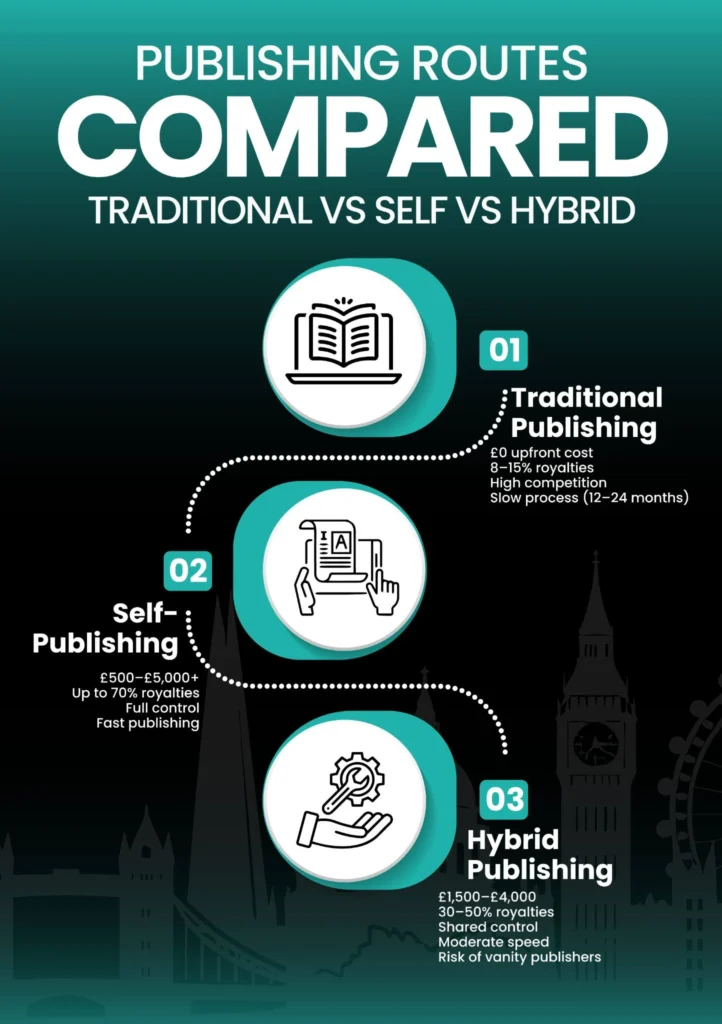
Traditional publishing is the most established route. In this model, the publisher takes full responsibility for the entire production process. This includes editing, design, printing, distribution, and often marketing.
You do not pay anything upfront. Instead, the publisher invests in your book and takes on the financial risk. In return, you earn royalties on each sale.
- Upfront cost: £0
- Royalties: 8%–15%
- Control: Low
- Time to publish: 12–24 months
Most authors need a literary agent to secure a deal. The submission process is highly competitive, and acceptance rates are low. However, this route still offers strong credibility in the publishing industry.
Self-Publishing
Self-publishing means you take full responsibility for producing and releasing your book. You cover all costs, but you also keep full creative and financial control.
- Upfront cost: £500–£5,000
- Royalties: Up to 70%
- Control: Full
- Time to publish: Weeks to months
Most authors use platforms such as Amazon Kindle direct publishing, IngramSpark, or Draft2Digital to publish and distribute their books globally.
This route offers maximum flexibility, but the total book publishing cost in the UK can vary depending on editing, cover design, formatting, and marketing decisions. These elements form a large part of overall book publishing expenses, especially for first-time authors.
Hybrid Publishing
Hybrid publishing sits between traditional and self-publishing. In this model, the author shares the cost of publishing with the publisher.
- Upfront cost: £1,500–£4,000
- Royalties: 30%–50%
- Control: Medium
- Time to publish: Moderate
Some hybrid publishers offer genuine editorial, design, and marketing support. Others operate more like vanity publishers, so careful contract review is essential before committing.
Publishing Route Comparison
Below you can see the comparison of publishing.
| Route | Upfront Cost | Royalties | Control | Risk Level | Time to Publish |
|---|---|---|---|---|---|
| Traditional Publishing | £0 | 8%–15% | Low | Low | 12–24 months |
| Self-Publishing | £500–£5,000 | Up to 70% | High | Medium | Fast |
| Hybrid Publishing | £1,500–£4,000 | 30%–50% | Medium | High | Moderate |
Stage-by-Stage Cost Breakdown of Self-Publishing
Self-publishing is not a single expense. It is a process with several stages where each stage carries its own cost, purpose, and level of importance. When authors try to understand the real book publishing cost in the UK, they quickly realise that the total budget depends entirely on how each of these stages is handled.
Most writers, especially those working within an indie author budget, are often surprised by how many decisions are involved before a book is actually ready for publication.
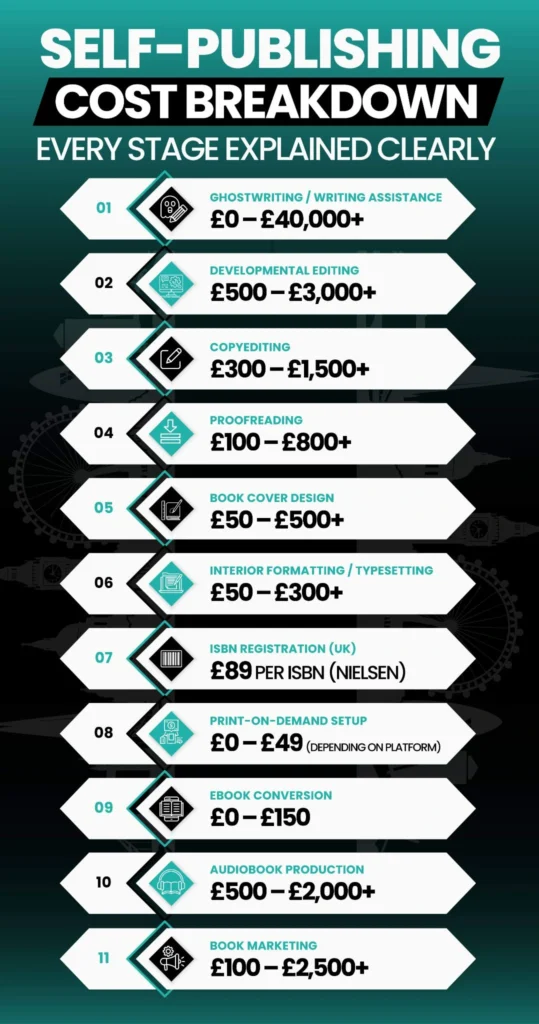
Ghostwriting or Writing Assistance
The first stage is the creation of the manuscript. Some authors prefer to write everything themselves, while others choose professional ghostwriters to shape or complete the content.
Ghostwriting is the most comprehensive option, where a writer produces the entire manuscript on your behalf. This can range from a few hundred dollars for small projects to over $40,000 for experienced industry professionals working on large or complex books.
Many new authors also turn to platforms like Fiverr, where writing assistance and editing services are more affordable and flexible, especially during early drafts.
Developmental Editing
Once the manuscript is complete, the focus shifts to structure and clarity. Developmental editing is where the foundation of the book is improved.
At this stage, the editor works on flow, organisation, and overall readability. It is not about grammar, but about how the content is shaped and whether it makes sense as a complete work.
The cost typically ranges from $0.07 to $0.12 per word, depending on the editor’s experience and the level of detail required. This stage is particularly important for non-fiction books where structure plays a major role in reader understanding.
Copyediting
Copyediting comes after structural editing is complete. This stage focuses on language refinement, including grammar, sentence structure, tone consistency, and readability.
It ensures that the manuscript reads smoothly and professionally without changing the author’s voice.
The usual cost ranges from $0.02 to $0.04 per word. Most authors consider this part of professional book editing, as it significantly improves the overall quality before publication.
Proofreading
Proofreading is the final quality check before a book is published. At this stage, the manuscript should already be well-edited, and the focus is on small but important details.
This includes correcting spelling mistakes, punctuation errors, and formatting inconsistencies that may have been missed earlier.
The cost is generally between $0.01 and $0.02 per word. Although it is the final stage, it plays a crucial role in maintaining a professional standard.
Book Cover Design and Illustration
A book cover is often the first thing a reader notices, which makes it one of the most important investments in publishing.
Thus, a simple pre-made cover can cost around $50, while a cover created by a custom book cover designer usually ranges from $150 to $500 or more depending on experience and style.
If the book requires visual content or artwork, illustration services can increase the overall cost further, especially for children’s or graphic-based books.
Interior Formatting
Formatting ensures that the book looks clean and readable in both print and digital formats. Even strong writing can lose impact if the layout feels unprofessional.
Many authors now use tools such as Atticus or Vellum to manage formatting themselves. However, if outsourced, professional book formatting typically costs between $50 and $300 depending on manuscript size and complexity.
ISBN Registration
An ISBN is required for distribution and identification. In the UK, ISBNs are issued by Nielsen and cost £89 per number.
Each version of a book requires a separate ISBN, including paperback, ebook, and audiobook editions. This makes it a necessary part of the overall ISBN cost UK structure.
Print-on-Demand and Book Printing Cost
Modern publishing has shifted heavily toward Print on Demand, which removes the need for large upfront printing costs.
Amazon Kindle Direct Publishing allows authors to publish for free, with printing costs deducted from each sale. In contrast, IngramSpark charges around £49 per title, along with a per-copy book printing cost that usually falls between £2 and £5.
This system, along with modern book printing services, has made publishing easier and reduced risk for new authors.
Ebook Publishing
Ebooks are one of the most cost-effective formats in modern publishing. The ebook publishing cost typically ranges from $50 to $150 if outsourced.
However, many authors publish directly through Amazon Kindle Direct Publishing, which allows them to reduce or completely eliminate this cost. This is also why the cost to publish a book on Amazon can remain very low.
Audiobook Production Cost
Audiobooks continue to grow in popularity, offering authors an additional revenue stream.
The audiobook production cost usually ranges from $500 to $2,000 depending on narrator experience and production quality. Some authors also choose royalty-share agreements, which reduce upfront investment while sharing future earnings.
Book Marketing
Marketing is the most flexible stage in the entire process. Some authors spend only a small amount, while others invest heavily depending on their goals.
Basic promotion may start from $100, while more structured campaigns can exceed $2,500. This may include ads, launch campaigns, and support from book marketing agencies.
Many authors also create a simple website, which usually costs between £60 and £500 per year depending on setup and hosting.
Publishing Cost by Genre — Fiction, Non-Fiction, Children’s, Poetry & More
Publishing costs vary depending on the type of book. Each genre has different production needs, which directly affect the overall book publishing cost in the UK. Some require only editing and design, while others need illustration, research, or specialist formatting.
Fiction Publishing Cost
Fiction books usually range from 60,000 to 100,000 words. The main costs come from editing, cover design, and formatting for print and ebook versions.
Since there are no illustrations or technical requirements, the cost to publish a novel is generally more predictable compared to other genres. Most of the budget goes into editing quality and cover design.
Non-Fiction Publishing Cost
Non-fiction books often require extra work beyond standard editing. This may include fact-checking, indexing, and structural improvements.
Indexing alone can cost $200–$500 depending on length. Because of this additional work, non-fiction publishing costs are usually higher than fiction, often by $500–$1,000 overall.
Children’s Book Publishing Cost
Children’s books are short in word count but heavy on visuals. Illustration becomes the biggest cost factor.
Professional illustrations can range from $2,000 to $10,000+, depending on detail and style. Many authors also share royalties with illustrators.
This is why the cost to publish a children’s book varies widely and is often higher than expected.
Poetry Book Publishing Cost
Poetry collections are usually low-cost to produce. Editing needs are minimal, and formatting is simple.
However, marketing plays a bigger role because the audience is smaller. As a result, the poetry book publishing cost is often shaped more by promotion than production.
Comic or Graphic Novel Cost
Graphic novels are one of the most expensive formats. Each page requires illustration, making design the main cost driver.
Costs depend on the number of panels and artist experience, which can increase the total significantly compared to text-based books.
Academic or Textbook Cost
Academic books are the most complex to publish. They require citations, permissions, peer review, and indexing.
These additional requirements make textbooks the highest-cost category overall, especially when compared to fiction or standard non-fiction.
| Genre | Editing Need | Illustration | Cost Level |
|---|---|---|---|
| Fiction | Medium | Low | £500–£3,000 |
| Non-Fiction | High | Low | £1,000–£4,000 |
| Children’s | Low | Very High | £2,000–£10,000+ |
| Poetry | Low | Low | £300–£2,000 |
| Graphic Novel | Medium | Very High | £5,000–£20,000+ |
| Academic | Very High | Low | £2,000–£10,000+ |
Each genre follows a different cost pattern. Understanding this early helps authors plan realistically and avoid unexpected expenses during publishing.
UK vs US Publishing Cost Comparison
Publishing a book in the UK and US follows the same general process, although the actual costs can differ quite a bit. Many authors comparing how much it costs to publish a book in the UK with book publishing in the USA usually notice that the variation comes from pricing, not the publishing steps themselves.
The difference becomes more noticeable when planning a budget for editing, design, and distribution.
Key Market Differences
Printing works differently in both regions. The US has a much larger publishing market, which often helps reduce costs when printing in bulk. UK printing and print-on-demand services, however, can sometimes be more cost-efficient for smaller quantities.
Tax rules also create a difference. In the UK, e-books have zero VAT, while physical books include tax within the final retail price. In the US, sales tax is added at checkout depending on the state, which changes the final price for readers.
Retail pricing follows a slightly different pattern as well. Books in the UK are often priced lower due to stronger discounting across retailers, while US books tend to maintain higher list prices.
Royalty structures can also vary. UK authors can sometimes reach higher Amazon royalty tiers at lower price points compared to US authors, which can influence pricing decisions.
Three Publishing Budget Tiers — Starter, Standard, and Professional
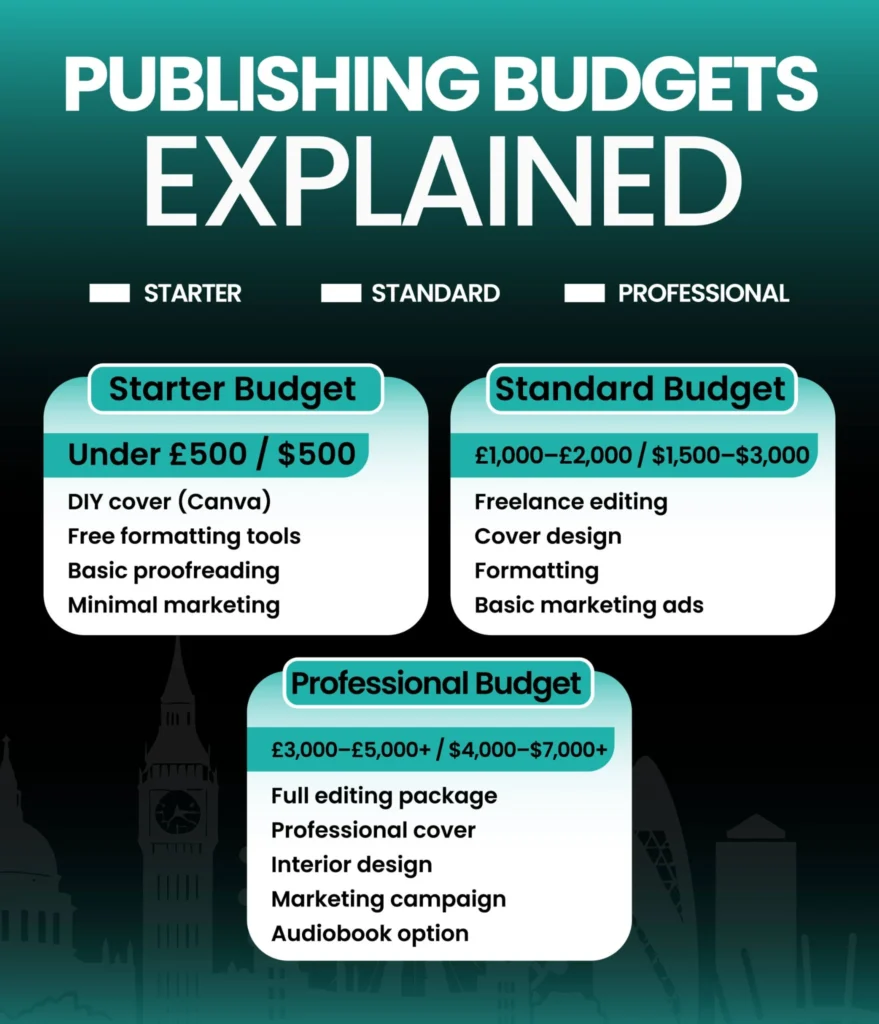
Publishing a book can be approached in different ways depending on budget and goals. Many authors exploring self-publishing on a budget choose a level based on how much work they do themselves and how much they outsource.
Starter Budget (Under £500 / $500)
The starter tier is the most basic route for authors looking for the cheapest way to publish a book.
This level keeps costs very low. However, most work is done by the author, so quality depends on skill and time invested.
Standard Budget (£1,000–£2,000 / $1,500–$3,000)
The standard tier is the most balanced option for affordable book publishing with professional support.
This level is suitable for authors who want a professional finish without high investment.
Professional Budget (£3,000–£5,000+ / $4,000–$7,000+)
The professional tier is for authors aiming for full market quality and strong launch results.
This level is often used by authors who want a strong commercial launch. Thus, the right choice depends on goals, expectations, and how much control an author wants over the publishing process.
Freelancer vs Agency vs DIY — Which Gives the Best Value?
Choosing how to publish a book is not only about cost, but also about how much control, time, and quality an author wants. The decision usually comes down to three main options: doing it yourself, hiring freelancers, or using a publishing service company.
Each option offers a different balance of cost and support, especially when planning how to hire book editor freelancer or decide between independent and full-service publishing.
DIY Publishing
DIY publishing is the lowest-cost option. Authors use tools like Canva for cover design, KDP for publishing, and Atticus for formatting. Most of these tools are free or low cost.
This route is ideal for tight budgets, but it is also the most time-intensive. The main risk is quality, especially if the author has no experience in editing, design, or formatting.
Freelancers (Reedsy, Fiverr, Upwork)
Freelancers sit in the middle range in terms of cost and quality. Platforms like Reedsy, Fiverr, and Upwork allow authors to hire editors, designers, and formatters directly.
This option gives more control and a direct working relationship with professionals. However, quality can vary, so it is important to review portfolios, check reviews, and request samples before hiring.
Freelancers are often the preferred choice for authors who want professional results without the high cost of a full agency.
Publishing Service Companies
Publishing service companies offer complete packages that include editing, design, formatting, and distribution support. This is the most expensive option but also the most hands-off.
While some companies are legitimate, others operate as vanity publishers. This makes it important to carefully evaluate any publishing service company before committing.
Red Flags to Watch
Some warning signs should never be ignored when choosing a publishing route. These include upfront fees from traditional publishers, loss of full royalty rights, unclear contracts, and hidden charges after signing.
Any company that guarantees success or demands large upfront payments without transparency should be treated with caution. These are common signs of a vanity publisher warning.
The best choice depends on how much control an author wants to maintain over the publishing process and how much time they are willing to invest.
Amazon KDP vs IngramSpark — Platform Cost Comparison
Choosing a publishing platform usually comes down to cost and reach. Amazon KDP and IngramSpark are often compared when planning the cost to publish on Amazon and wider distribution.
Amazon Kindle Direct Publishing (KDP) has no setup fee. It is free to upload books. Authors earn around 35% or 70% royalty on ebooks depending on pricing. Print books usually offer around 60% royalty after printing costs, which are charged per page.
On the other hand, IngramSpark works differently. It charges an IngramSpark setup fee of around £49 or $49 per title. Thus, it is not free, but it offers wider distribution to bookstores and libraries, making it stronger for print reach.
Platforms like Draft2Digital and PublishDrive work as aggregators. They usually have no setup fee but take a percentage of royalties while distributing to multiple retailers.
Most authors use both KDP and IngramSpark together. KDP is used for Amazon sales, while IngramSpark is used for wider distribution.
So, most authors use both Amazon KDP and IngramSpark together. KDP is used for Amazon sales. IngramSpark is used for bookstores and libraries.
This combination helps reach both online and offline readers.
Break-Even Calculator — How Many Books Do You Need to Sell?
Publishing ROI is important before investing money. It shows how many books must be sold to recover costs.
The formula is simple. Total publishing cost divided by profit per book gives break-even sales.
Example 1
Publishing cost is £1,500. Profit per book is £3.
£1,500 ÷ £3 = 500 books to break even
Example 2
Publishing cost is £4,000. Profit per book is £5.
£4,000 ÷ £5 = 800 books to break even
Reality Check
Most self-published books sell under 250 copies. This makes planning important when thinking about break-even book sales.
Books in a series often perform better over time. Each new release helps increase total sales. Thus, a break-even calculator can help authors estimate their own numbers more clearly.
10 Proven Ways to Reduce Publishing Costs Without Cutting Quality
Reducing publishing expenses does not mean lowering quality. Most successful authors focus on smarter planning rather than cutting essential services. Small decisions at each stage can significantly reduce the overall budget.
1. Start with Self-Editing
Reviewing your manuscript before hiring a professional editor can make a big difference. A cleaner draft reduces editing time and lowers overall costs. This is one of the simplest ways to manage how to publish a book cheaply without affecting quality.
2. Use Beta Readers Early
Feedback from beta readers or writing groups helps identify issues before professional editing begins. This early stage feedback is usually free and can prevent unnecessary revisions later.
3. Use Affordable Design Tools
Tools like Canva and Atticus allow authors to create covers and formatted interiors without hiring expensive agencies. Many independent writers achieve professional results using these platforms while keeping costs low.
4. Compare Professional Quotes
Editing and design prices can vary widely between providers. Comparing multiple quotes often reduces costs for the same level of work, especially when planning affordable book publishing.
5. Buy ISBN Bundles
Purchasing ISBNs in bundles is more cost-effective than buying single numbers. This is especially useful for authors planning multiple formats such as ebook, paperback, and audiobook editions.
6. Use Print-on-Demand Services
Print-on-demand reduces upfront costs by printing books only when they are ordered. This helps authors avoid bulk printing expenses and lowers financial risk.
7. Build an Audience Early
An early reader base can reduce marketing costs after publication. Authors with organic reach often spend less on paid advertising during launch.
8. Join Author Communities
Writing communities often share trusted service providers, discounts, and publishing advice. This can help reduce trial-and-error spending during the publishing process.
9. Work with Emerging Freelancers
New editors and designers with strong portfolios often offer lower rates. This can be a cost-effective way to access quality services when budgets are limited.
10. Publish in Stages
Starting with an ebook allows authors to earn early income. That income can later support print and audiobook versions without requiring a large upfront investment.
Conclusion
Publishing a book is less about a fixed cost and more about making the right decisions for your goals. Some authors choose low-cost paths, while others invest more in editing, design, and marketing to improve results.
The key is to match your budget with your publishing expectations rather than following a one-size-fits-all approach.
Whether you choose to publish independently or use professional support, the most important step is to publish your book in a way that aligns with your long-term goals.
For authors looking to improve quality, exploring book publishing services in the UK such as editing, cover design, and marketing support can make a significant difference in your success.